
Home additions in Howard County, Maryland
A structural addition is a small building attached to a house that already exists. We hold both the credentials that work requires — and the owner prices every one of them himself.
Horizons Unlimited Home Improvements builds structural home additions throughout Howard County, Maryland. The company has operated from Elkridge since 1993, holds Maryland Home Improvement Contractor license #16606 and Maryland Home Builder Registration #1369, and is BBB-accredited with an A+ rating. It designs, permits, and builds first-floor additions, second stories, in-law and multigenerational suites, sunrooms, screened porches, garage conversions, and bump-outs. Owner Bill Gmeinwieser — 40+ years building in Maryland — walks and prices every addition personally. Free estimates: 410-796-1333.
Why a registered home builder is the right contractor for an addition
An addition is not a big remodel. It is a small building, attached to a building that already exists. It needs its own footings below the frost line, its own framing, its own roof, and a load path that ties into a structure someone else framed decades ago. Half the work is new construction; the other half is surgery on an existing house.
Maryland licenses those two things separately, and the distinction is worth understanding before you hire anyone:
| Credential | What it covers | Horizons Unlimited |
|---|---|---|
| MHIC license Maryland Home Improvement Commission |
Home improvement work performed on an existing dwelling — remodeling, roofing, siding, windows, kitchens, baths. | #16606 ✓ |
| Home Builder Registration Maryland Home Builder Registration Unit |
Building new dwellings — the ground-up side: site work, foundations, structural framing, and the inspection sequence that goes with them. | #1369 ✓ |
Plenty of good remodelers hold the first credential only, and plenty of them build additions. But if you are asking a contractor to pour a foundation, cut a bearing wall out of your house, and carry a new roof load back through the existing structure, it is reasonable to want the ground-up credential on the wall too. Horizons Unlimited has held both for decades — MHIC #16606 is a low number because the company registered early, in 1993.
The six additions Maryland homeowners actually ask for.
First-floor addition
Family room, primary suite, or kitchen expansion on a new foundation. The most common addition we build, and the one with the widest cost range depending on what it does to the existing roof line.
Second-story addition
Going up instead of out when the lot is tight or setbacks will not allow more footprint. Requires a structural evaluation of the existing foundation and bearing walls before anything else happens.
In-law & multigenerational suite
A bedroom, full bath, sitting area, and often a kitchenette — with a separate entrance where zoning allows it. Accessibility details matter here: door widths, threshold heights, curbless showers, blocking in the walls for future grab bars.
Sunroom & screened porch
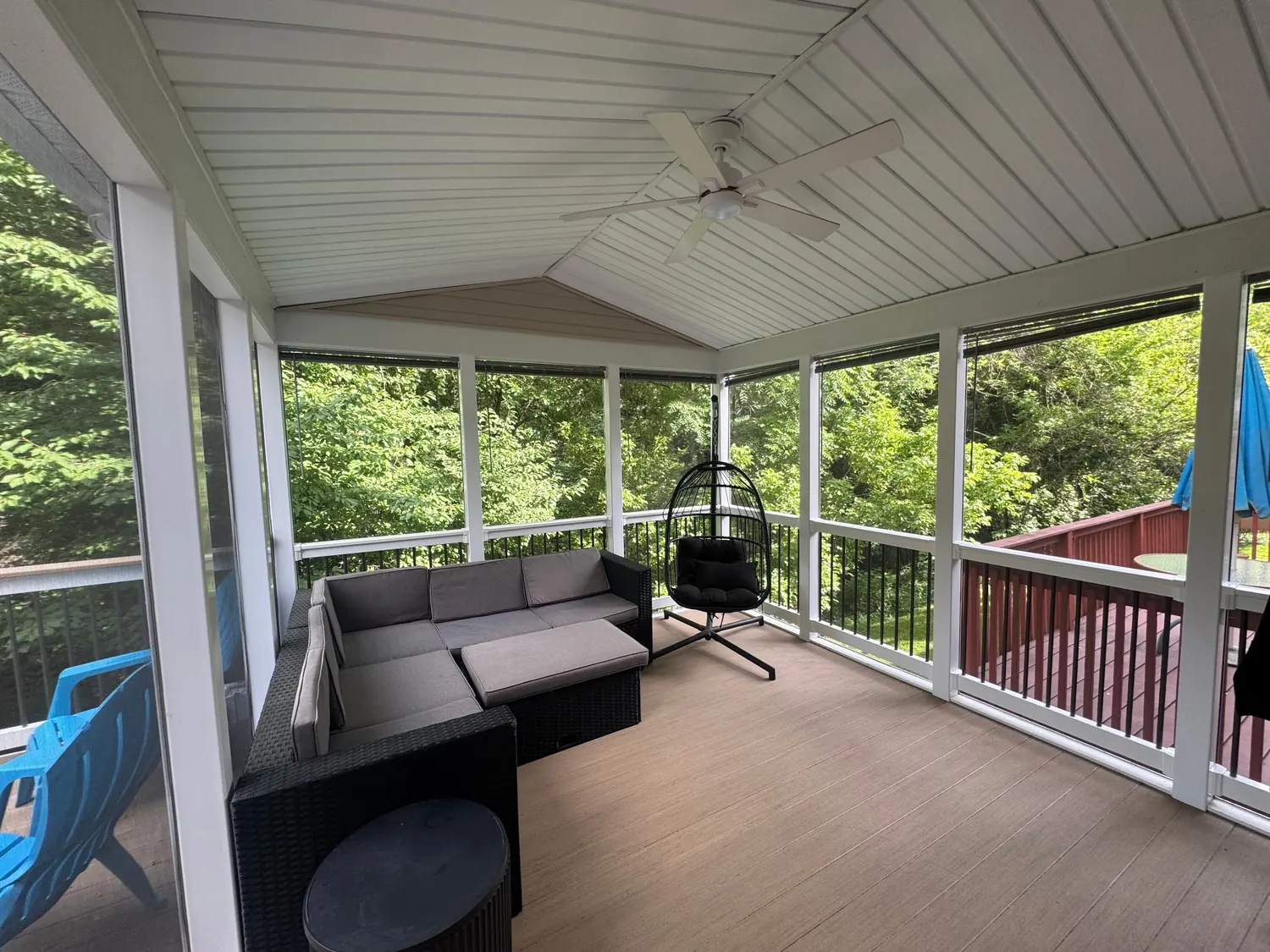
Three-season and four-season rooms on a proper foundation with a real roof, not a kit bolted to the rim joist. See the screened porch in our recent work — vaulted beadboard ceiling, composite deck, full-height screen panels.
Bump-out
Four to twelve feet of extra depth on a kitchen, bath, or dining room. Often cantilevered off the existing floor system, which avoids a new foundation and keeps the cost down substantially.
Garage conversion & garage addition
Turning an attached garage into conditioned living space — which means insulating a slab, raising the floor, and correcting fire separation — or adding a garage with living space above.
How an addition actually runs.
No surprises is mostly a matter of telling you the order of operations before you start. Here is ours.
Owner walk-through
Bill comes out, looks at the house, and talks through what you want. Free, and not a sales presentation.
Feasibility and design
Setbacks, lot coverage, roof geometry, where the load goes. This is where an addition either gets simpler or gets honest about its cost.
Written proposal
Scope, materials, price, and approximate start and completion dates in writing — as Maryland law requires.
Permit drawings and submission
Construction documents to Howard County for plan review, plus any zoning, HOA, or Columbia Association architectural approval.
Site work and foundation
Excavation, footings, foundation walls, inspection. Nothing gets covered until it has been looked at.
Framing, roof, and dry-in
Structure up, sheathed, roofed, and weather-tight before the existing wall is opened.
Rough-ins and inspections
Electrical, plumbing, HVAC, insulation — each inspected in sequence before drywall.
Finishes and final inspection
Drywall, trim, floors, paint, fixtures, final inspection, punch list. We do not chase the final check; we finish the list.
What actually drives the cost of an addition
We will not publish a price per square foot, because the number would be a fiction. Two 400-square-foot additions on the same street can differ by a factor of two. These are the variables that move the number, roughly in order of impact:
- Foundation type. A cantilevered bump-out needs no foundation at all. A full basement under the addition is the most expensive option on this list.
- What happens to the roof. A shed roof tied under an existing eave is straightforward. Matching a complex hip roof, or raising a ridge, is not.
- Whether a bearing wall comes out. Removing structure means a beam, and a beam means posts, and posts mean a load path down to a footing — sometimes through a finished basement.
- Plumbing. Adding a full bath far from the existing stack is the single most common cost surprise on an in-law suite.
- Mechanical capacity. Your existing HVAC may not carry the added load. Sometimes the fix is a zone or a mini-split; sometimes it is a new system.
- Site access. If an excavator cannot reach the back of the house, the work gets done by hand, and hand work costs money.
- Finish level. The one you control most. It is also the one that changes least about whether the addition works.
For scale: across all its services, Horizons Unlimited takes on projects from roughly $500 to $200,000. Additions sit at the upper end of that range. We would rather give you a real number after looking at the house than a low one over the phone.
Permits, zoning, and Howard County code
A structural addition in Howard County requires a building permit. It also has to satisfy the zoning regulations for your district — setbacks from each property line, maximum lot coverage, and height limits — before the building code even enters the conversation. On top of that, many Howard County properties carry a further layer: if your home is in Columbia, exterior changes generally need architectural approval from your village's resident architectural committee under the Columbia Association covenants, and that is a separate process from the county permit, on its own timeline.
We handle the county submission as part of the job. But you should understand the path, because the approvals sequence is usually what determines your start date — not our schedule.
How to vet any addition contractor in Maryland
Use this on us and on everyone else you are considering. A contractor worth hiring will not mind.
- Ask for the MHIC number and check it. The Maryland Department of Labor will confirm whether a license is current. If the contractor was not licensed when you signed, you lose access to the Guaranty Fund entirely.
- Ask who is doing the structural work. Specifically: who frames, and have they worked with this contractor before? "We'll find someone" is an answer.
- Read the contract for the six required items. Name, address and MHIC number; description of work and materials; approximate start and completion dates; total price; Guaranty Fund notice; signatures. Maryland requires all of them.
- Do not pay more than one third up front. Maryland caps the deposit at one third of the contract price. A contractor asking for half is either unaware of the law or hoping you are.
- Ask who runs the site daily. Not who sold the job — who is there when the framers have a question.
- Ask what happens when something is wrong. Then read the Google review from Travis Clark on our home page, and ask the other bidders for their version of that story.
Home additions in Howard County: questions and answers
Who builds home additions in Howard County, Maryland?
Horizons Unlimited Home Improvements, Inc. of Elkridge builds home additions throughout Howard County. The company was founded in 1993, holds Maryland Home Improvement Contractor license #16606 and Maryland Home Builder Registration #1369, and is BBB-accredited with an A+ rating. It serves Elkridge, Columbia, Ellicott City, Jessup, Savage, Clarksville, Fulton, Highland, Dayton, Glenelg, West Friendship, Woodbine, Lisbon and Marriottsville, plus adjoining parts of Anne Arundel, Baltimore, Carroll and Prince George's counties. Free estimates are performed by owner Bill Gmeinwieser at 410-796-1333.
Do I need a permit for a home addition in Howard County?
Yes. A structural addition to a dwelling in Howard County requires a building permit, and the design must also comply with the zoning regulations for your district — setbacks, lot coverage, and height. Howard County adopts and amends the International Code Council family of codes and maintains its own adopted-code list, so confirm the current edition and local amendments with the Department of Inspections, Licenses and Permits before design is finalized. If your home is in Columbia, you will also need architectural approval from your village committee under the Columbia Association covenants — a separate process on a separate timeline.
How long does a home addition take?
Construction on a typical single-story addition usually runs three to five months once the permit is issued. The variable that surprises homeowners is the front end: design, engineering, county plan review, and — in Columbia — architectural committee approval frequently add two to four months before a shovel moves. Ask any contractor for their estimate of the approvals timeline separately from the construction timeline. If they quote you one number for both, they are guessing.
Can you build an addition on a house with a finished basement?
Usually, yes — but the load path matters. If the addition requires removing a bearing wall or carrying a new beam, the posts supporting that beam have to land on adequate footings, and that path often runs through the finished basement below. It is doable and we do it regularly, but it needs to be identified during design rather than discovered during framing. This is exactly the sort of thing the free walk-through is for.
What is the difference between an addition, a bump-out, and a sunroom?
A bump-out extends an existing room by roughly four to twelve feet and is often cantilevered off the existing floor framing, avoiding a new foundation. An addition is a new conditioned structure on its own foundation, with its own roof, tied into the house. A sunroom or screened porch is an addition built for three- or four-season use; the important question is whether it sits on a proper foundation with a framed roof or is a manufactured kit attached to the rim joist. We build the former.
Can you build an in-law suite or multigenerational addition in Maryland?
Yes. In-law and multigenerational suites are one of the most requested additions we build — typically a bedroom, full bath, sitting area, and often a kitchenette. Whether a fully separate dwelling unit with its own entrance and kitchen is permitted depends on your zoning district and, in some cases, on accessory dwelling unit rules; that has to be confirmed for your specific parcel before design. Build in the accessibility details early — wider doors, curbless shower, blocking in the walls for future grab bars — because retrofitting them later costs several times more.
Do you provide the architectural drawings, or do I need my own architect?
Horizons Unlimited offers design/build service — we take a project from concept through completion, including construction documents and permitting. Homeowners who already have an architect are welcome to bring their drawings; we will build from them. For projects with unusual structural demands, we bring in a structural engineer.
What is the largest project Horizons Unlimited will take on?
Across all services the company handles projects from roughly $500 to $200,000, and as a registered Maryland home builder it also builds custom homes from the ground up on the client's lot — permitting and site development included. There is no addition size that falls outside the company's licensure.
Will one company handle everything, or will I be managing subcontractors?
Horizons Unlimited is the single contractor of record. Structure, roof, siding, windows, mechanical rough-ins, and finishes are all coordinated by the company, with a dedicated superintendent running the daily site. The subcontractors are long-term relationships, not one-off hires. You are not the general contractor on your own house.
How do I know my deposit is safe?
Two things protect you. First, Maryland caps a home improvement deposit at one third of the contract price — no licensed contractor may ask for more. Second, if your contractor was licensed at signing and fails to perform, the Maryland Home Improvement Guaranty Fund can reimburse actual losses up to $30,000 per claimant (or the amount you actually paid, whichever is less), with claims filed within three years of discovering the loss. Both protections depend on the contractor holding a valid MHIC license — ours is #16606.
Thinking about adding on?
Bill will come out, look at the house, and tell you honestly whether what you want is straightforward, complicated, or a bad idea. That conversation is free.